Are disconnected ERP, CRM, and legacy databases slowing your decisions and AI initiatives?
ISHIR connects your existing systems through modern data integration, APIs, and CDC without unnecessary platform replacements.

Your Salesforce CRM says a customer is worth $2.4 million. Your ERP reports $1.8 million in recognized revenue. Finance has another number, and your AI analytics tool confidently reports a fourth. Which one should your CEO trust?
This is what enterprise data silos look like in practice. They are not simply disconnected databases. They are conflicting business definitions, delayed decisions, incomplete customer records, operational blind spots, and expensive reconciliations that happen every reporting cycle.
The situation becomes more serious when organizations introduce AI agents that automatically analyze data, recommend actions, and execute business workflows. If those agents operate on fragmented or inconsistent information, they can accelerate the same mistakes that employees previously discovered during manual reviews.
According to Salesforce’s 2026 Connectivity Benchmark Report, 96% of surveyed IT leaders believe AI agent success depends on seamless data integration across enterprise systems. Yet 50% of AI agents currently operate in isolation, and 40% of organizations identify outdated infrastructure and disconnected systems as a major barrier to using enterprise data for AI.
The solution is not necessarily to replace Salesforce, SAP, NetSuite, SQL Server, or your existing cloud platform. It is to establish a unified data architecture that connects these systems, standardizes how business data is interpreted, and makes trusted information available where it is needed.
The question for business leaders in 2027 is no longer whether they need enterprise data integration. It is how they can eliminate data silos without disrupting the systems that already run their business.
Enterprise data fragmentation has existed for decades, but AI adoption is exposing its operational consequences much faster.
Accenture’s May 2026 research, covering executives from 2,000 companies across 15 countries and nine industries, found that only 7% had reached the level of data readiness required to scale advanced AI. The research also reported that 72% lacked trusted data of the necessary quality supported by standardized governance practices.
Source: Accenture, AI-Ready Data, May 2026
A separate 2026 study by Precisely identified data quality as the leading data integrity priority for 51% of surveyed data and analytics leaders. Although 94% of organizations had at least started planning or approval activities to improve data quality for AI, only 55% were actively executing those initiatives.
Source: Precisely, 2026 State of Data Integrity and AI Readiness
These findings highlight a growing disconnect between enterprise AI investment and the condition of the data infrastructure supporting it.
Organizations are attempting to automate business decisions before establishing trustworthy relationships between customers, orders, financial transactions, products, and operational events.
The result is a serious management problem: AI applications may operate faster than the systems responsible for validating their information.
Sales teams often make commitments based on CRM information without complete visibility into inventory, manufacturing capacity, delivery schedules, or financial restrictions.
Consider a U.S. distributor whose sales organization uses Salesforce while its operations team runs SAP. A salesperson promises delivery within five business days because the opportunity meets the customer’s requirements. However, the actual inventory is allocated to another customer, and the ERP indicates a longer replenishment cycle.
The discrepancy may remain invisible until an order reaches fulfillment. By then, the customer has received a commitment that operations cannot meet.
How enterprise data integration solves it: Connect relevant Salesforce opportunity and order information with SAP inventory availability, fulfillment status, and delivery commitments using supported APIs or event-based integrations. Define which system owns inventory availability and which owns the customer-facing promise. Refresh information at a frequency appropriate to the transaction.
The goal is not to duplicate SAP inside Salesforce. It is to expose the required operational facts through controlled integration.
The sales team reports booked revenue. Finance reports recognized revenue. Operations reports fulfilled orders. Executives compare the numbers and assume at least one department has made a mistake.
Often, the problem is not the individual reports. It is that each system calculates a different metric.
Bookings, billings, recognized revenue, collected cash, and annual recurring revenue are different measures. They should not be treated as interchangeable merely because they relate to the same customer.
A unified data architecture must preserve those distinctions while connecting the underlying records.
How to fix it: Establish shared identifiers, a governed financial data model, transaction-level reconciliation rules, and documented metric definitions. Where appropriate, integrate NetSuite, SAP, and SQL Server data into a governed analytics environment.
Modern data infrastructure should allow finance to trace a metric back to its source transactions, not merely display a consolidated number.
A company may maintain one customer in Salesforce under a corporate name, another in NetSuite under a billing entity, and several subsidiary records in SQL Server.
The same commercial relationship might therefore appear as multiple customers.
This creates inaccurate customer lifetime value calculations, duplicate outreach, disconnected support histories, and incomplete credit exposure assessments.
The problem becomes particularly dangerous when AI-powered customer intelligence systems use those records to recommend account priorities or identify expansion opportunities.
How to fix it: Introduce customer identity resolution, master data management, cross-system identifier mapping, and survivorship rules. Identify which system is authoritative for specific attributes, such as legal entity, billing address, commercial owner, and contractual status.
Do not automatically merge two records simply because their company names or email domains look similar. Parent companies, subsidiaries, franchises, and separate legal entities may require distinct records.
A green pipeline status does not guarantee current business information.
A data pipeline can complete successfully while reading an outdated source extract, missing a changed record, processing an incomplete batch, or failing to apply a deletion.
A CFO might receive an updated-looking dashboard that does not contain the latest adjustments. A customer service agent might see an invoice as outstanding even after payment has been recorded.
These are data freshness and correctness problems, not simply infrastructure uptime problems.
How to fix it: Establish freshness expectations for each business-critical dataset. Monitor source-to-target lag, event processing, completeness, reconciliation, and schema changes. Use change data capture where supported and justified by the required latency.
Real-time integration is valuable when the business must act on changes quickly. For monthly financial reporting, a reconciled batch process may be more reliable and less expensive.
Imagine a customer service AI agent receiving this request:
“Check whether this customer’s order has shipped, confirm payment status, and determine whether we can authorize a replacement.”
The required information might exist in Salesforce, SAP, NetSuite, and a SQL Server-based warranty application.
Even if the AI agent can retrieve information from all four systems, it still needs to understand which customer record is correct, which status is authoritative, whether the information is current, and whether it has permission to authorize a replacement.
Connecting databases without defining these rules creates another layer of operational risk.
How to fix it: Provide AI agents with approved, purpose-specific data services. Apply access permissions, business rules, source attribution, and human approval for consequential actions. Separate read-only analytical access from transaction-changing operations.
AI agents should not receive unrestricted database access simply because they can interpret natural-language questions.
Mergers and acquisitions frequently leave organizations with multiple ERPs, CRMs, reporting platforms, and custom applications.
Replacing every acquired system immediately can introduce enormous implementation risk, especially when those applications support revenue-generating operations.
Yet leadership still needs consolidated financial reporting, customer visibility, procurement intelligence, and compliance monitoring.
How to fix it: Build an integration architecture that establishes common business entities and reporting standards while allowing acquired systems to remain operational. Introduce standardized connectors and a shared analytical model, then modernize individual applications when there is a separate business justification.
A unified data architecture allows integration and application replacement to follow different timelines.
Many enterprises have accumulated custom scripts, scheduled exports, middleware jobs, and direct database connections over years of development.
A change in one application unexpectedly breaks several downstream systems. Engineers spend hours identifying which dependency failed, while business users discover the issue through missing transactions.
The architectural issue is tight coupling.
How to fix it: Use versioned APIs, reusable integration services, message queues where appropriate, formal data contracts, and centralized monitoring. Define error-handling behavior, retry policies, and data ownership before production deployment.
Replacing dozens of fragile scripts with one ungoverned integration pipeline merely creates a larger single point of failure.
The most practical approach is to keep existing business applications as systems of record and connect them through supported APIs, change data capture, scheduled extraction, and a governed integration layer.
The architecture should make enterprise information available to analytics platforms, business applications, and AI systems without requiring the underlying operational systems to be replaced.
However, the integration method must reflect each system’s capabilities. Salesforce events, SAP business APIs, NetSuite analytical connectors, and SQL Server transaction-log capture are not interchangeable technologies.
Salesforce supports several integration interfaces, including REST APIs, Bulk API, and Pub/Sub API.
REST APIs are appropriate for controlled access to records and business operations. Bulk API is useful when handling large-volume data extraction or loading. Salesforce Change Data Capture events allow external applications to receive information about supported record changes.
For example, when an account or opportunity changes, a subscribed integration service can process the event and update the corresponding downstream representation.
The implementation must account for API limits, event retention, replay recovery, object support, identity mapping, and eventual consistency.
An important design decision is determining whether the receiving system needs a copy of Salesforce records or merely requires a business event that triggers another workflow.
Technical reference: Salesforce API selection
SAP should generally be integrated through approved business interfaces rather than unrestricted reads from application database tables.
SAP S/4HANA provides documented APIs for integrating business processes, accessing supported entities, and connecting external applications. SAP Integration Suite can help orchestrate integration across heterogeneous systems.
For example, an organization can expose relevant sales order, business partner, inventory, or procurement information using APIs supported by its SAP deployment.
The specific interface depends on whether the organization uses SAP ECC, SAP S/4HANA on-premises, or a cloud edition, as well as installed functionality and available APIs.
Avoid assuming that every SAP business object can be extracted or updated through the same method. Authorization, business logic, transactional consistency, and deployment-specific interfaces matter.
Technical reference: SAP S/4HANA APIs
NetSuite supports SuiteTalk REST Web Services for supported record-oriented operations. It also provides SuiteAnalytics Connect for analytical access through ODBC, JDBC, or ADO.NET.
These interfaces serve different purposes.
SuiteTalk REST Web Services may be appropriate for supported application integration workflows that need to read or modify records within authorized permissions.
SuiteAnalytics Connect is a read-only analytical interface. Oracle explicitly advises that it is best suited to static or less frequently changing information and warns that real-time usage patterns can cause performance problems.
There is also an important 2026 compatibility issue: Oracle states that the older NetSuite.com analytical data source is no longer available beginning with NetSuite 2026.1. Integrations relying on SuiteAnalytics Connect must use NetSuite2.com.
This illustrates why enterprise data integration cannot simply be treated as installing a connector once and forgetting about it.
Organizations need connector lifecycle management, schema compatibility testing, permission reviews, and documented recovery procedures.
Technical reference: Oracle SuiteAnalytics Connect
Technical reference: NetSuite2.com migration requirements
Microsoft SQL Server supports change data capture, which records inserts, updates, and deletes for enabled tables and makes those changes available to downstream consumers.
Unlike repeatedly copying an entire table, CDC can allow data integration services to process the changes that occurred since a prior checkpoint.
For example, a legacy order management database may contain millions of historical transactions but only a fraction of those records change during a particular period.
A properly configured CDC pipeline can propagate relevant changes to an analytical platform without performing continuous full-table reloads.
However, CDC is not automatically zero-latency or zero-maintenance.
Teams must monitor transaction log processing, capture lag, retention windows, schema changes, initial snapshots, replay behavior, and downstream consumer checkpoints. Missing the available change retention window can require a resynchronization.
For workloads that only need to identify which rows changed, SQL Server Change Tracking may be sufficient. It is not equivalent to CDC because it does not preserve the same historical change information.
Technical reference: Microsoft SQL Server CDC
Once enterprise data is extracted or exposed through supported interfaces, organizations need to decide where integrated analytical information should be processed.
Depending on existing investments, the target platform might be Snowflake, Databricks, Google BigQuery, Microsoft Fabric, or another suitable environment.
The architecture should separate raw ingestion from validated business data. Transformations should resolve identifiers, standardize data types, preserve historical information when required, and apply documented business rules.
Cloud infrastructure provides scalable processing and storage, but it does not independently resolve inconsistent customer identities or conflicting definitions of revenue.
Those problems require data modeling, governance, and business ownership.
A unified data architecture is not necessarily a single physical database. It is a coordinated set of integration, processing, governance, and access capabilities that makes enterprise data usable across business systems.
A practical architecture contains five layers.
Salesforce continues to manage customer relationships and sales processes. SAP or NetSuite continues to perform the financial or operational functions assigned to it. SQL Server continues supporting legacy application transactions.
The first principle is to preserve application ownership.
Analytics pipelines should not become unauthorized alternatives for executing financial transactions or changing operational records.
This layer connects source systems using methods appropriate to their capabilities.
APIs expose supported business functions. CDC captures database changes. Event streams distribute relevant business events. Scheduled extraction handles workloads that do not require continuous updates.
All integrations should have authentication, retry handling, error isolation, logging, and rate-limit controls.
Raw data needs to be transformed into consistent enterprise information.
Customer IDs, product codes, timestamps, currencies, organizational hierarchies, and transaction definitions must be reconciled. Data quality checks should identify missing records, duplicated entities, invalid relationships, and unexplained changes.
A common mistake is to treat matching column names as matching business meanings.
Two databases may both contain a field named “customer_status” while assigning completely different meanings to its values.
This layer establishes consistent definitions for business concepts such as active customers, net revenue, gross margin, outstanding orders, and inventory availability.
Data lineage identifies where information originated. Access controls determine which employees and AI systems may use it. Semantic models explain how related entities and measures should be interpreted.
This is where enterprise data integration becomes genuinely useful to business decision makers.
Power BI, Tableau, operational applications, customer-facing tools, and AI agents consume approved information through governed datasets and services.
Not every consumer needs direct access to the warehouse. Some require a controlled API, some need an analytical query interface, and others need event notifications.
A modern architecture should support these different access patterns without creating another collection of disconnected data products.
There is no single integration method that solves every data silo problem. The appropriate approach depends on the data source, business requirement, latency target, transaction sensitivity, and operating cost.
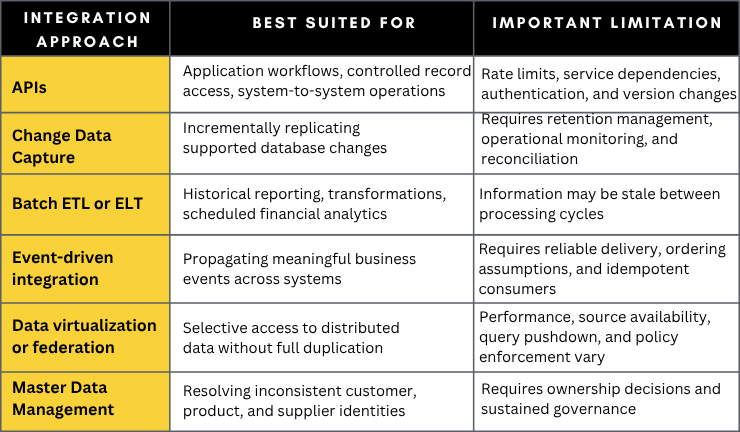
For example, a company that wants near-real-time order status may need event-driven integration or CDC. The same organization may only need a nightly reconciled financial data pipeline for management reporting.
Building every pipeline as a real-time stream increases operational complexity without necessarily improving business outcomes.
The right integration architecture is defined by business decisions, not by the number of technologies it contains.
No. AI can accelerate data discovery, mapping, quality analysis, and integration development, but it cannot independently determine which enterprise data is authoritative or which business rules are correct.
AI-assisted tools can suggest mappings between fields, identify potentially duplicate records, generate transformation logic, explain pipeline failures, and help engineers investigate unfamiliar schemas.
For example, an AI system may recognize that a Salesforce account field resembles a NetSuite customer field. It can propose a matching rule and help analyze exceptions.
It cannot safely assume that the two records represent the same legal entity, or that a particular subsidiary’s revenue should be consolidated under a parent account.
Those decisions require domain knowledge, finance and operations input, and explicit governance.
Automated schema discovery: AI-assisted analysis can help engineering teams understand unfamiliar databases, identify relationships, and document legacy fields. Generated interpretations must be checked against source documentation and business processes.
Intelligent data quality monitoring: Machine learning can identify unusual changes in transaction volumes, missing values, duplicates, and distribution patterns. Teams still need deterministic validation rules for critical financial and operational metrics.
AI-assisted pipeline development: Engineers can use AI to draft extraction logic, transformation code, tests, mappings, and documentation. Human review remains necessary for correctness, security, scalability, and error recovery.
Natural-language data access: With appropriate semantic models and governed query execution, users can ask business questions without writing SQL. Accuracy depends on trusted metrics, permissions, and source freshness.
Data incident investigation: AI can help correlate failed jobs, schema changes, logs, and data quality alerts. Production remediation should follow documented controls rather than giving agents unrestricted authority to alter data pipelines.
AI can make integrated data infrastructure more productive. It cannot substitute for the architecture and accountability that make enterprise information trustworthy.
There is no credible universal price for eliminating enterprise data silos because integration complexity depends on more than the number of applications involved.
Connecting two well-documented SaaS platforms for scheduled reporting may be substantially simpler than integrating an extensively customized SAP environment with multiple SQL Server databases and real-time operational workflows.
The main cost drivers include:
1. Source-system complexity: Application versions, customizations, API support, connector availability, and legacy database constraints.
2. Data volume and freshness: Historical extraction requirements, change frequency, and whether updates must happen continuously.
3. Business transformation complexity: Identity matching, financial reconciliation, historical modeling, and metric standardization.
4. Security and governance: Permission mapping, auditing, privacy requirements, data residency, and compliance controls.
5. Infrastructure and operations: Cloud processing, storage, integration tools, monitoring, maintenance, and recovery procedures.
Consider a hypothetical U.S. enterprise with eight analysts and operations employees spending six hours per week each reconciling information across systems.
At a modeled fully loaded labor cost of $75 per hour:
Annual manual reconciliation cost = 8 × 6 × 52 × $75 = $187,200.
If an integration initiative reduces that effort by 70%, the modeled annual capacity value is $131,040.
This is an illustrative calculation, not a measured industry benchmark. It represents potentially recoverable work capacity, not guaranteed cash savings.
A complete business case should also consider integration development costs, recurring platform expenses, maintenance, incident reduction, faster order processing, improved collection cycles, and avoided business errors.
The most persuasive modernization investment case connects technical improvements with specific operating or financial outcomes.
ISHIR helps businesses address fragmented enterprise data through architecture assessment, enterprise data integration, API engineering, change data capture implementation, and modern data platform development.
The starting point is understanding which business processes are constrained by disconnected information. This includes identifying the systems that own critical data, mapping integration dependencies, assessing data quality, and determining whether existing platforms can support the required analytical and AI workloads.
ISHIR can help organizations design integration patterns for Salesforce, SAP, NetSuite, SQL Server, and cloud data environments while preserving appropriate systems of record. The implementation approach may combine APIs, CDC, batch pipelines, cloud data engineering, and governed business data models, depending on the requirements and capabilities of each source.
The objective is to create a reliable foundation for enterprise analytics, operational applications, and AI initiatives without forcing an unnecessary replacement of existing enterprise software.
Learn more about ISHIR’s Modern Data Infrastructure Services.
ISHIR connects your existing systems through modern data integration, APIs, and CDC without unnecessary platform replacements.
You can eliminate many data silos by integrating existing applications through supported APIs, CDC, scheduled extraction, and governed analytical services. Keep your ERP and CRM as systems of record while standardizing important business entities and metrics across platforms. A unified data architecture allows employees, applications, and AI agents to access consistent information without forcing every system onto one database. Begin with the business process causing the greatest operational or financial friction.
Connect each platform using the interfaces it supports. Salesforce provides APIs and record change events, SAP offers supported business APIs and integration services, NetSuite provides REST Web Services and analytical connectivity, and SQL Server supports CDC and other extraction methods. Ingest the required information into a governed integration or analytical layer, then reconcile identities and define common business metrics. The result is a unified view without replacing the operational applications.
AI can assist with schema discovery, field mapping, pipeline code generation, duplicate detection, documentation, and troubleshooting. However, it cannot safely determine authoritative business definitions, legal entity relationships, access permissions, or financial reconciliation rules without human oversight. Successful AI-assisted enterprise data integration still requires a documented architecture, approved business logic, data quality testing, and operational controls.
Data integration connects information from multiple systems so it can be used together while the original applications may remain operational. Data migration transfers information from one system or platform to another, often as part of an application replacement or modernization program. An organization trying to unify Salesforce and SAP reporting may need integration rather than migration. Migration becomes necessary when there is a justified decision to change the system of record or underlying platform.
CDC can be more efficient when downstream systems need frequent updates from supported databases because it processes changes rather than repeatedly extracting entire datasets. Traditional batch ETL remains appropriate for scheduled reporting, complex reconciliations, or systems where reliable change capture is unavailable. CDC also requires monitoring, retention management, checkpoints, and recovery logic. The correct choice depends on business latency requirements and source-system capabilities rather than a general preference for real-time processing.
Yes. Salesforce and NetSuite can exchange supported business information through APIs, integration middleware, or other suitable connector patterns. For analytical reporting, NetSuite also offers SuiteAnalytics Connect, subject to licensing and account configuration. The integration should establish clear ownership for customer records, orders, invoices, and financial transactions. Replacing either platform is not inherently necessary to create coordinated workflows or consolidated reporting.
Start by defining customer identity at the correct business level, such as legal entity, corporate parent, subsidiary, or commercial account. Establish cross-system identifiers, matching and survivorship rules, data stewardship, and exception handling. Automated matching can improve efficiency, but ambiguous records should be reviewed before they are merged. A master data management strategy should prevent duplicate identities from repeatedly reappearing across integrated systems.
For many organizations, a hybrid architecture is the practical starting point. Existing databases remain operational, while APIs, CDC, or scheduled ingestion move appropriate information into a cloud analytical platform. Data quality rules, identity resolution, governance, and semantic models create consistent information for downstream use. Some workloads may benefit from federation rather than replication. The final design should account for network connectivity, source-system performance, security, latency, cost, and regulatory requirements.
The timeline depends on scope and complexity. A focused integration involving a small number of accessible systems may be implemented more quickly than a program involving several customized ERPs, historical identity issues, and regulated information. A 90-day initiative can be a useful starting framework for assessment, implementation, validation, and measurement of an initial use case. Eliminating enterprise-wide fragmentation is typically an incremental program requiring ongoing governance.
Costs depend on the number and complexity of systems, data volume, source licensing, integration frequency, security requirements, transformation logic, and ongoing operations. An API-based reporting integration may require substantially less engineering than real-time financial reconciliation across multiple customized platforms. Request an architecture assessment that separates implementation expenses from recurring infrastructure and maintenance costs. Evaluate the investment against reduced manual effort, fewer data errors, improved process speed, and measurable business outcomes.
The post How to Eliminate Data Silos Without Replacing Your ERP, CRM, or Legacy Databases appeared first on ISHIR | Custom AI Software Development Dallas Fort-Worth Texas.


