
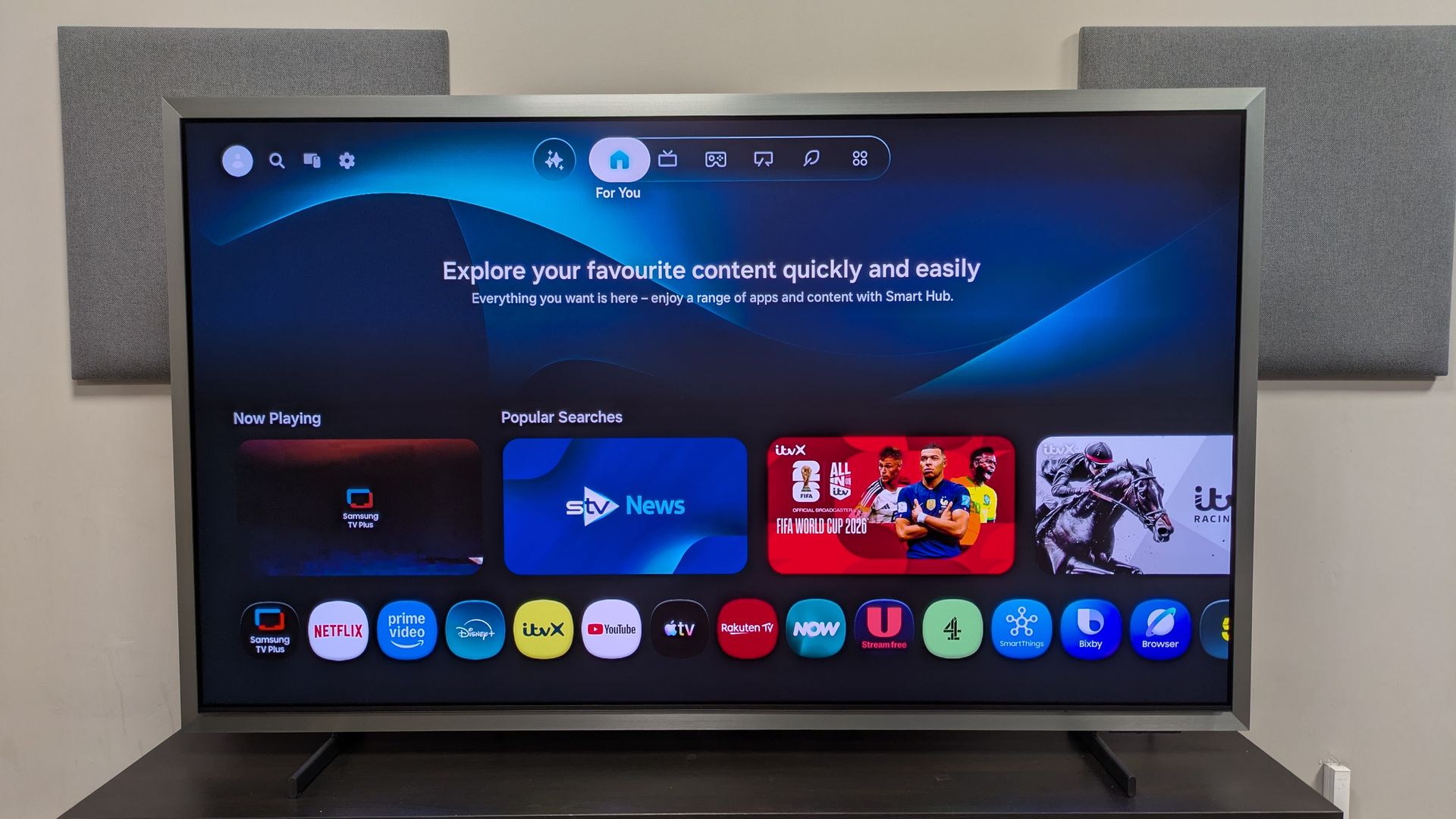
- Samsung TVs can report dog barks and baby cries to Samsung
- TVs can detect mics in soundbars and other devices
- It's not as sinister as it's being painted online
Privacy has always been a hot-button topic online, and since the furore over LG TVs' data collection people have been paying particular attention to televisions and associated accessories.
So the latest news about Samsung TVs seems rather scary: according to a thread on Reddit, it has "on-device AI listening for your dog and baby, watching what you watch, and borrowing your soundbar's mic if the TV doesn't have one."
That sounds appalling, but when you look into the detail the picture becomes considerably less sinister. Some of the supposed spying Samsung is doing isn't secret: in some cases it's for features Samsung happily advertised as reasons to buy its TVs.
That doesn't necessarily mean that Samsung is doing everything with complete transparency, or that there might be more data collection and retention than you're aware of. But it does mean perhaps putting down the EVERYBODY PANIC! signs and looking at what the TVs are actually doing.
What are the claims about Samsung TVs?
According to an X user called log4j, they started digging into their Samsung TV's data use when the on-screen ads were getting very specifically targeted. And in the latest batch of data they've published, they found markers for dog-barking and baby-crying events, data on camera streaming duration, and a feature that can detect microphones in nearby devices.
Scary, right? But the AI baby crying detection was a feature Samsung advertised under the name Family Care as a key selling point: the idea was that if your TV detected a child's cries, it would send alerts to your connected mobile devices. And Samsung's already said that it is discontinuing the feature — 18 months after it launched — due to low usage and persistent false positives, for example because it was detecting on-screen crying as if it happening for real.
What about the dog barking? That's a related system, Pet Care, which is designed to do the same for dogs as it does for babies' cries. Both systems are designed to work when the TV is on standby.
It maybe be fair to criticize Samsung for not making it clear it reported such events to its own servers, and to ask why it needs to. We've asked Samsung for comment on the latter, though there's probably a clue in the fact that it's discontinuing the feature due to lack of use and its performance — it's standard for companies to collect some data on if and when features are used, so they can analyze and adapt them. In any case, Samsung was hardly hiding Pet Care and Family Care. Quite the opposite.
What about looking for external microphones? As far as I can see from the posts on X, the TV only looks to see if nearby devices have a microphone — there's no evidence that it uses them secretly. It's entirely possible that there's a simple reason for it, for example to enable karaoke apps or video calling apps, so that when you fire up those apps the TV already knows which microphones are available. Discovering nearby devices is not the same as accessing them; if it were, we'd be demanding a ban on Bluetooth.
Further data is promised from the Samsung TV software breakdown, and it might reveal that there are some dodgy deeds going on: the same hacker says that the TV loads a region-specific neural network to monitor your use of apps such as YouTube, and a detailed breakdown of what's going on there is apparently imminent.
But for now it seems that Samsung maybe more has a privacy policy issue, not a sinister snooping plan. If more data emerges and it demonstrates something more serious, I'll be as outraged as anyone else.
I think we're way overdue a big conversation about how much data TV hardware and accessory firms should collect, especially in the US where data protection hasn't been a massive legislative priority compared to places like Europe. But I don't think this particular story is as worrying as tales of TV makers telling advertisers that "we own the glass".
We've contacted Samsung for comment and we'll update this article if it responds.


